Sunday, December 15, 2019


N  104  A Day Trip to Nam Koke

Nam Koke is a small town about an hour drive from Taunggyi. It is on the Taunggyi Loikaw road. I happened to visit it a few days ago.

I had made arrangements with my friend Daw Sao Mya Waddy to visit Nam Koke but on that day we drove separately in our own cars. Sai Leng took us by the Kakku road which branched towards the east at about 10 miles from Taunggyi.  From there on we drove along unpaved road passing neat Pa Oh villages, fields of garlic and other crops, and at one place a small group of old pagodas.

 The paddy fields were just harvested. Some paddies may have reached the barns of the farmers, but some were still lying in the fields in bundles and not yet threshed. Some threshed paddy stalks that have become hay can be seen lying around as simple hay stacks. This reminded me of the hay stacks I had seen in Australia. Because everything is done by machine there packing hay will surely be done by machine that their hays are rolled neatly to become a round cylinder like bundle. But this is Shan State and we are living our own way.

The scenery was stunning. The vast land and fields dotted with golden bundles of paddy and hay stacks spread towards the low blue mountains in the distant , that the scenery looked like a magnificent panorama. Panoramas on all sides. I imagine what a good photo this panorama would  become if taken by a good photographer.

After driving for some time we reached a concrete bridge and then saw the expected small river . Sai Leng told us that this is the river from which its water is planned to divert to use in Taunggyi where water resource is scarce.

We stopped here, got out of the car , took some photos and then moved on again. We got  to the end of the road where it meets the paved road and to my surprise saw that we have reached Nam Koke, and this made me happy that we had reached our destination.

It still is early to have lunch, but we have to eat , so we looked for a place to eat and settled at a restaurant which look nice and ordered lunch. Although the compound of the restaurant is not big , the owner had taken care to make it impressive, using wood and logs for decoration. Beside the main room there are some small compartments where about up to 10 people can sit and eat, and these are parted with logs or wood with some plants in between, To come in we have to cross a small bridge which span over a drain where colourful fishes are swimming. Not bad decoration for a small restaurant in a small town I thought. And the food is not bad too, though the price was not cheap enough.

After we had eaten my friend and company had arrived  and while waiting for them to finish eating we enquired for some places to visit and were told there was a festival ground at the end of town. So we got into our car and headed there. We saw vehicles standing by at one place and people in new Shan dresses streaming out onto the street at one place and assumed that this must be the place. We parked the car at the edge of the festival ground and got out.

When I am at home I never go to festivals. The Tazaungdaing festival had gone by yearly but I would never lay my feet on the ground.I don’t like walking a long way especially among crowds as it is tiresome. But this small festival made me feel happy. It reminded me of these kind of festivals we had enjoyed in our hometown when I was young.

The short dusty lane in front of us was crowded with people, who were coming out or buying things at the stalls that were stretching along the lane in front of us. The stalls were selling usual festival goods such as toys, Shan dresses,  headdresses, and bags and hats.There was also a stall selling warm clothes and woollen hats.The shopkeepers were people who came from other towns and cities.

This festival was held to celebrate   the past Tai New Year and also offering of new harvest to the Lord Buddha.The people enjoying the festival were mostly Shans (Tais  )wearing Shan dresses. Even small children were dressed in cute Shan costumes. There was no entertainment at this time of day,but there may be some shows on the stage at night. But people were enjoying themselves, strolling around the ground, eating, buying things especially what their children badger them to buy for them. My small grandson got a toy guitar and with that he climbed onto the empty stage and acted like strumming it and singing and enjoying himself which made us and some bystanders smile happily.

At this time my friend and her company had finished their lunch and so we joined them to visit another place. It was a group of old pagodas , said to be built by the famous Keng Tung Sawbwa’s sister Nang Tip Htilar and is about 3 miles out of town. They were situated on a hill which overlooks all sides. On reaching the top we saw some partly collapsing old pagodas and a large banyan tree with some branches cut down near them.My friend is interested in restoring the pagodas and she discussed about it  with the engineers she brought with her. They have experiences in building and restoring old pagodas like these. They gave their own views concerning the restructuring of the pagodas.My friend has her own plans to do so and I hope she will succeed in realizing her dream.

We visited a flower farm with plans to take photographs among pretty flowers . But the flowers were all harvested by this time that there were no flowers to see at all.

By this time we were all tired, that even our little monkey had fallen asleep by himself at the back seat . So we headed home. We came back by the KBZ road which is reached by driving some miles out of town.Then through unpaved road passing some settlements, and fields until we came to the paved Pin Pet road.After some miles the road join the main Hopong Taunggyi road.

I posted on my facebook account in Burmese;
A visit to Nam Koke
Nam is water and koke means mortar  ( where we pound rice )powered by running water
It can be reached about an hour
went one way and came back by another
I was contented to travel on these new routes
Without expecting, visited a small festival there
It was  to celebrate   the past Shan New Year and also the offering of new harvest to Lord Buddha
Even if it is a small village festival, seeing these old and young Tai people in traditional dresses make me feel enchanted and happy….


Wednesday, July 3, 2019

N 103  Green Taunggyi @ Nar Poung

 Nar Poung village is about 8 miles from Taunggyi, on the Taunggyi – Kakku Road.It was the place we looked for to plant trees after Sin Taung. At first we checked at Loi Kaung monastery compound, but found it was already packed with trees,and the monk directed us to look at Nar Poung. So we came to be at this place which is farther away from Taunggyi , but were excited and happy to find a vast compound where hundreds of trees can be planted. We also got permission from the Abbot to plant trees in the compound.


It was June 30th when we went to plant there. For this day’s planting our Green Taunggyi group was joined by a walking group of 30, who are friends of USTM. After eating breakfast of fried rice and fritters at our gathering place we left for Nar Poung, amid mists and light rain, taking with us tree saplings, tools, stakes, sacks of fertilizers, and some refreshing drinks.


The compound is a perfect place for tree planting. Only some places are weedy while most of the place is covered only with grass. But I heard that there are termites, so I prayed that all of our trees will not be destroyed by these pests.


As holes had already been dug by workers the group happily planted the tree saplings and after about an hour or so nearly 400 trees were planted and marked by bamboo sticks which made the field more attractive.
So our third day of tree planting at Nar Poung ended without mishap or inconvenience which left everyone satisfied and happy with renew spirits to plant more the coming week.


Monday, July 1, 2019

N 102      Green Taunggyi

During summer this year, before the rain came, Taunggyi was very hot, hotter than any other years , people said. Facebook posts and other medias pointed out the disadvantages of trees disappearing and urging people to grow more trees. I could not resist the urgings and so decided to form an environmental group to plant trees, do some educative movements, such as erecting billboards and hold some public meetings to discuss environmental issues.

 So with confidence that I will be able to do so with the help of my two daughters, who are also interested in environmental issues, I decided to form a group which is the first thing to be done. I called a meeting with the people I had in mind , who will be acting as ECs and asked them to participate in the group, and nobody disagreed about their positions. I took the part of patron only along with two others with Sayagyi U Sein Aung as chairman.

For some members I recruited office and plant workers from our Mya Nanda Tun construction. My aim is if young people who participate in tree planting become interested in environmental issues it will be good for them and also the environment.For other members I asked some from my surroundings and they joined willingly. Some joined by their own wishes after I posted on FB.

I named our group Green Taunggyi which need no explanation other than to make Taunggyi green with more trees and thus leading to a better climate and environment. As for funds I don’t expect to cost much, and so will be taken care by me and my family.

So three meetings were held to explain why Green Taunggyi was formed and how to plant trees. And also to form groups which will enable them to have more interests in their group and be more responsible for their parts.

Meanwhile members of the EC prepared (bought ) the needed equipment such as earth drilling machine,bush cutter, hoes, shovels and spades. Bamboo sticks to mark the plants had to be ordered. Some members went to Taung Lay Lone to buy manure and  burnt paddy husk to use as fertilizers. I have to add that preparing fertilizer is somewhat tiresome. The dried manure have to be pounded and then mix with burnt paddy husk and put in sacks to distribute to the planters. This job is done only by staunch members who are willing to give time and energy for tree planting.

Then we have to look for places for the planting. We had received 1ooo trees from the forest department and that is the number our group was determined to plant this year. One acquaintance  took us to his village, Sin Taung, to a monastery which is bare except for a few trees. We inspected the place and all were pleased to have found such a nice place for the trees. We estimated that it will be enough not only for this year planting but also for years to come.

So on 19th June , the day when the whole country was planting in commemoration of State Councilor’s birthday , we all went there to start planting trees. Some digging had already been done by some members and I heard discouraging news that the soil is hard and full of stones. My daughter took a backhoe from her father’s batching plant and dug some days which resulted in the entire southern side of the monastery full of big sandy holes. Some as deep as 4 feet and still no soil or earth can be found. Some have some earth in them , but to  put in a plant  they have to be filled again with earth which is very tiring.

After 2 days ( 19th and 23rd ) we haven’t planted many trees. I had calculated to plant 250 trees each day , but it was far from the expectation. I was discouraged and want to look for other places.I was also afraid that members who are planting found this place too tiring and depressed.But my daughters don’t want to give up yet. Some said  that  trees can be planted by filling up the pits with earth and that Swedaw trees thrive well in such places.As Swedaw is not in our collection we went to Taung Lay Lone plantation to buy them.

Well for the time being I can only  expect for the day when young people succeeded to fill this rocky high ground with greeneries.

Meanwhile some of us had located a place where we can plant trees by hundreds. It is at Nar Paung village , in its monastery compound.And had hired a worker to dig as many holes as he can. It should be volunteer work , but there are not many in our group who can do this work.So money has to be used for the digging.

Tomorrow , the 30th of June some of us are going to plant there. Only some of us will be going because some members from a walking group volunteered to join us. So I will narrate about Nar Paung tree planting only in my next blog….


Friday, November 9, 2018

N 101  How Shans celebrate the end of Buddhist Lent (Thadingyut )

Among the most celebrated religious days the Thadingyut ( end of Buddhist lent which usually falls in October )is the most significant and important one. Buddha in his time is said to spend lent in Tavatimsa which is the abode of celestial beings, preaching to his late mother who was one of them.

On the full moon night of Thadingyut the Lord was to descend to earth (Singatha
nagou ) accompanied by his entourage of high ranking monks and sanghas.To welcome the Buddha to earth people built gold and silver and ruby stairways decorated  lavishly and brilliantly with lights.

In commemoration of this event the people of Myanmar celebrated Thadingyut in this way by lighting their homes and environments and religious places. This  festival is celebrated for three days when schools and workplaces are closed and everybody enjoys some holidays. 

In our Shan State on the eve of the full moon day men of the household prepare to build a small stage or platform with four bamboo poles and split bamboos. It has a floor and the sides except the front is covered partially with woven bamboo strips called yarzamat. At the farther end of the platform a small altar with a Buddha statue is placed. In front of the altar a bowl consisting of a coconut, some bunches of bananas, betel squid, fermented tea leaves, and tobacco are placed as offerings to the Buddha. At night incense and candles are also offered.

On the bamboo poles which hold the platform banana trees, sugarcane leaves, young coconut leaves, paddy plants, flowers and small colour flags are tied decoratively. Under the platform fruits like coconut, oranges, pomeloes, sweet potatoes, sugarcane, bananas, cucumber ,groundnut, and all kinds of fruits are hanged. These all are offerings to Lord Buddha, so as to gain merit and at the same time to get a bountiful harvest of the crops.

On the eve of the full moon day people prepare foods to offer to Buddha early the next morning.The already acquired various fruits and nuts are washed and cleaned and kept together with  jams and biscuits and  snacks. All kinds of sweet potatoes, ripe pumpkin are steamed. Those who have more than enough share with their neighbours.

On the full moon day people get up before dawn to prepare food offerings to Buddha. They peel, they skin, they cut fruits and prepare the hsoon cups with cooked rice as the basic item. Then the fruits, nuts, jams, special snacks and steamed food are arranged carefully over the rice,to form a pretty hsoon offering. Over ten bowls have to be prepared. When these are ready the elder and  the family gather and sit in front of the 4 pole stage and the elder first invited the Lord Buddha to come and reside in the altar to accept the offerings. Then all the family members paid homage to the Buddha and recite prayers.

After the offerings to Buddha are  finished family members do the other offerings with the ready made bowls of food. The most common offerings are made to  Guardian Spirits of the house, the village, the town and the district. And then to deceased parents and grandparents, the guardian spirit of the fireplace, the main gate, the front door, the ladder, the well, the money or treasure box, the rice barn etc. We believe that these are to bring good fortunes and keep the family from bad things.

After the household offerings of the early morning is finished people prepare to go to the village monastery. The people dress themselves in the best attire and with offerings depart for the monastery. Sometimes village people go together in a procession accompanied by ozi boun moung ( drums and gongs ) with tounaya and keinayar dance.

Village people then offered their offeteries to Sanghas and pay homage to them. Then prayers are said and monks give their blessings to the villagers. Merit is shared before libation water is poured and the ceremony comes to an end, when villagers departed for their homes.

After that people, especially young ones started to go around to visit and pay homage to parents , grandparents and elders of the village with offeteries, sometimes with rice and curry packs only. Sticky rice  is wrapped in plantain leaves and the curry is usually minced meat or fish wrapped in plantain leaves and steamed until it is cooked well as is the custom of Shan people. Shan people put much effort in this kind of merit making. They would go to far away places on foot and sometimes last even a month or so.

The festival last 3 days and nights. At nights people light candles and lanterns at pagodas and monasteries and at their homes. Lights can be seen everywhere and people would be in festivities mood. Nowadays there may be a stage show or some kind of entertainment to celebrate the end of Buddhist Lent which is also called the festival of lights


Thursday, August 23, 2018

N 100   Our Brethren, the Palaungs of Shan State

During the past 2 days there was a sensation on facebook, caused by a live video posted by an account holder with the name Yuri Miko. She videoed a group of Palaung people of Makmoung Lao, which is between Namsang and Kholam in Southern Shan State, in night time. And she said these Palaung people are maneaters and they are a kind of spirits called kyats.Many people who know the Palaung people including me became outraged by her remarks and so sharing, commenting, counter
attacking, defending the victims, unmasking and scolding the poster overflow into FB pages.

Why…. what had caused these commotions on FB ? Because it is untrue. The Palaungs are one among the 135 ethnic people of Myanmar. They are from the Mon- Khmar race, not like the Shans who are from Tai Shan Tayoke race. But they live in the Shan State only, mainly in the northern parts of Shan State, which centered around the town Namsang.This place is a hilly region and the Palaung there cultivated tea for their livelihood. They are called Shwe Palaung which means golden Palaung and they are more developed than Palaungs residing in Southern Shan State,in townships of Namsang,Kunhing, and Merng Peing.

Palaungs are devout Buddhist and they build big monasteries in their villages. They also like to go for pilgrimage to famous religious places and pagodas. Because they live in remote hilly regions most of them cannot acquire much education. But now schools have reached them and they are starting to send their children to school. Some well to do Palaungs even send their children to boarding schools in towns.

Their main livelihood is cultivation of crops. In the past they grew opium for their living. But now as opium does not fetch good price and maybe because of some other reasons they switched to other crops like maize and corn. Even then some people’s lives are not good enough due to lack of education, their backwardness, and exploitation by more advanced people.

 Some of them had to move to other places because the land they had been living for decades were confiscated from them. While driving from Hsai Moan to Wan Sing near Kholam last March I saw them building new bamboo huts at a place. It was a sign that they had moved from other place. Even now some don’t have a permanent place to settle down, a place to call home.

People living in and around Kunhing township are pitiable. Some maybe well off and own cars, brick houses, motor cycles, and luxurious items, but most of them are poor and underpriviledged.Worse than that some have become addicted to drugs like amphetamine and stimulant pills and have to work as labourers in road making.

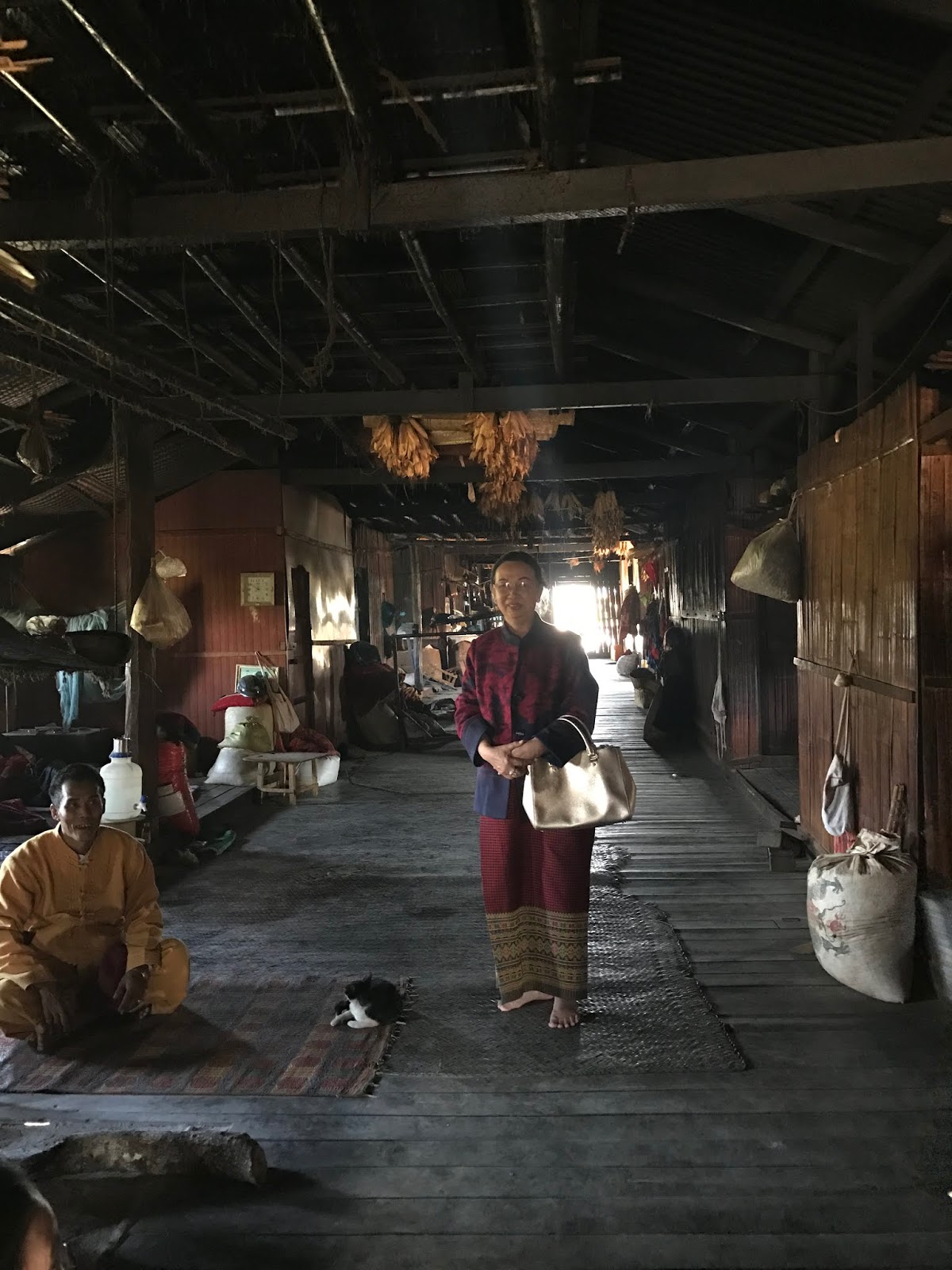
The Palaungs have their own language and many can understand the Shan language, though their culture are different from the Shans. They live in long, dark,bamboo and thatched houses.. A family has its own fireplace on one side of the middle pathway. One can count how many families are living in the house by counting the fireplaces.

As for their dresses men wear cotton shirts of vivid colours like green, red and blue, and extremely loose black trousers. Women wear long striped skirts tightened at the chest, which they weave themselves, and wear multicoloured short double breasted jacket for the upper part.The colour of the women’s skirt vary according to the tribes. Some wear black with red stripes and some wear bright purple colour with stripes. Women wear big silver ear studs and wide silver belts around their waist. Both men and women like to chew betel nut wrap and make their teeth black As for the hair men wear their hair long but women shave their head after they get married.


I have been writing about the Palaungs I know to clear the misunderstandings about them caused by the FB post. I have never lived closely to these people, so I don’t know  them intimately. But I believed what I had written is not wrong. Anyway we Shans and the Palaungs had lived side by side peacefully for decades and we know that they are nice, ignorant, simple people.

So I cannot stay silent when I see they were insulted by words. In this case the mistake was done by only one, but the message had done great damage to the Palaung's image, lest people believe what she had said. In the future people using facebook should be careful about what they say or write in their postings. Should refrain from posting about what we don't know well.


Monday, June 18, 2018


N 99   Bagan in My Heart  ( Part 2 )

The first time I went to Bagan was in 1967  I think, in my 4th year of Uni; but our excursion group met with an accident at Popa and couldn’t continue to Bagan. Later after I worked I led students group( and later Lanzin youths ) for excursion to Burma Proper that included Bagan. So that was the first time I had been to Bagan when I was met by its awe inspiring sight.It captured my heart and can be said love at first sight.

We visited all famous pagodas; The gilded Shwe Zigon , the most visited Ananda with its 4 perfect standing Buddhas, the Sulamani which has the most beautiful architectural design, The Dhammayangyi which is said to be the biggest , the highest Thatbyinyu, Htilominlo, Mahabawdi, in Bagan, and Manuha and Mya Zedi in Myinkaba and many other stupas  and pagodas.  

Many of the big pagodas then have an inner narrow  stairs to the upper tiers and people can get to the top to  look around. I wondered why women should be let to go up as the upper part is higher than the Buddha statues, but now nobody are allowed to go up  to save damaging them.

In those days the places around Bupaya, Shwe Gu Gyi, Thatbyinyu, gawtawpalin , Bagan museum Thiripyitsaya were crowded with houses and shops .So the place was not nice and clean like today.

Hotels were not much popular yet, so we usually stayed at monasteries and zayats. It was rather convenient for us and nobody complained, but were satisfied to see the awesome Bagan.

Judging by the number of pagodas built during that time we assumed that Bagan would have flourished , and the people done  well. The number counted now is 2217. During that time not only  kings and queens and noble people built pagodas but also ordinary people did that. But in my mind it is strange that palaces ( even their foundations ) could not  be found.

Later I visited Bagan many times, sometimes with family, and sometimes with friends.During these times,  sometimes we visited Tant Kyi Taung where we had to cross the Ayarwaddy by watercraft. It is opposite of Lawkananda Pagoda and is on a lofty mountain. On Bagan’s side before entering Bagan is the Tuyin Taung which was built on a hill not far from the roadside.At the foot of the hill there was Mya Kan lake built by King Anawrahta to use its water to irrigate the lands around it. But nowadays  there are  no distinct features of it left.

Though it is hot and dusty it gives people a sense of missing, which in Burmese we called( lwan de) but cannot express  exactly, fully in English .It is a kind of missing, of yearning but to what and to whom we don’t know. We can see famous writers like Zaw Gyi, Min Thu Wun, Mya Than Tint and Maung Thar Cho  express this feeling  in their books , and in their poems. I think many  people who are in Old Bagan feel like this and I am one of them.

And then about its inexplicable  mysteriousness;

Maung Thar Cho wrote
       
   ….. on sleepless nights I would go out with a friend through these pagodas. On these nights the Tamar would smell more strongly….Under the moonlight the greenish htanaung trees looks so mystic…..The standing pagodas and stupas here and there looks as if they are mesmerizing with some magic and I feel as if I am being watched by some supernatural being.

In another chapter the author wrote that while he was riding in a horse cart and passing the Dammaryangyi the driver told him that he dare not go past the pagoda at night because moanings can be heard coming from that direction.The author Nanda Thein Zan also wrote incidents that are not natural in his book.
       
  I believe in soul. So I can understand these things . Bagan is an old, ancient city. Innumerable people had lived and perished in it.Some naturally and some opposite of it. But I am afraid of supernatural things. I won’t dare go out in the night like the author in the book, although I like to see the old city in the daytime.
Bagan is an arid place. Only small bushes and trees like htanaung and tamar can grow in the rusty soil. Without the amazing monuments of worship with their architechural and cultural value, the people of long ago built, the place is worth nothing. But because of these things it is famous all over the world and has become a place of attraction. So we must know its value and cherish it and take care of it ,so that it will last a long time.

Wednesday, June 6, 2018

N   98  Bagan in my heart

I had been reading a book about Bagan. It was written by author Maung Thar Cho, and the title is “ Lacquer smelling pages of a semi desert “

In the book the author narrated every thing about Bagan; its history written by Burmese historians like Dr Than Tun and also foreign scholars as well.

Beside history with it’s kings the author also wrote some incidents concerning famous and infamous pagodas, about spirits that came into existence during the Bagan era, fable like stories such as Kyansittha and his 3 heroes, , Bagan’s connections with Thiho ( Ceylon ) and also Mount Popa, and poems about Bagan written by famous poets.

And then about steles of which Mya Zedi is the most famous. We know from the book that the 1st person who discovered it was Dr.E Forchammer, a professor of English from Yangon College in 1886 and that the interpreter was a German scholar Dr. Charles Otto Blagden who worked in Singapore and Indonesia.This made me wonder why it had always been foreigners who discovered old monuments like Angkor Wat, Borobudur, and now our Myazedi Stele. 

We had known all along that Mya Zedi stele was erected by Yarza Kumar , son of Kyansithar and Thambula and it depicted his gratitude to his father. Some paragraphs in the book gave us doubts about Yarza Kumar being the son of Kyansithar and Thambula.

Well…. history cannot be said to be a hundred percent true. Historians have to assemble the facts, clues, relics and sayings handed down from old people to young people to make history. Anyway, true or not true Bagan had been great during its days, that even widows can build pagodas that lasted a thousand years with a number of over 2000.

The author wrote :
This much grand a past
This much majestic a history
This much artful and magnificent bygone days
This much bright and radiant yesterday……
Oh…. Bagan, I value  you as my life

And then he said he loves Bagan; to drink tea from lacquer smelling tea cups, to eat lahpet from a lacquer bowl, to haul water from a well with a lacquer pail and bath, to sit quietly under a hta naung tree encircled  by a red earth footpath, to go and pay homage to serene pagodas with distinquished historical backgrounds. He liked all of these that he had visited Bagan uncountable times.

Another book about Bagan that I like is the book written by Nanda Thein Zan. The title is “ Thoughts about Arimadana still lingering “. I had read and bought it more than once . It was what the author and some friends discussed about Bagan old days which left the author with thoughts.I like the somewhat poetic way that it was written.

So , through what I have read and seen in reality I  also come to like Bagan. I had been to Bagan many times though not as much as the author , but I don’t feel I have had enough of it….

to be continued…..