Saturday, February 18, 2017


 N  86   Continuation of  The Water Dripping Ceremony 
                              in Kunhing   Shan State

The next day the 8th was for entertaining guests who came from far and near to make some donation. The Shans take this custom so seriously. If they are invited they would try to come and donate some money as much as they can whether it be a small sum or a big one. The donors take care of the food and guests are treated the whole day. The cooking and serving groups are specially organized, and everybody do their tasks unitedly.  They stay leisurely as long as they can listening to Sar Haw before going back.
     
The 9th was the most important day because the purpose of the occasion will be fulfilled and completed that day. When we reached the new Dammaryone it was already full with people who were taking part in this water dripping ceremony .At the top of the hall, in front of the altar the Abbot  and invited Sanghas had already taken place with offertories lining in front of them.Donors each held a small jug filled with water and a cup to catch the water when it is dripped from the jug. It means that we the donors had donated for the sake of merit to enjoy this life and in after lives. We have donated with a clear cut mind and without any attachments. And we want to share the merit to all beings. So let all beings hear of this good deed and receive the sharing we are making.
        
Saya U Tun kyaw  made  explanations about the building of the Dhammaryone and read out the names of the major donors ( a board showing all the names of the donors was also erected outside the building )After that Lung Saray Aw read out a long lanka in Shan language which he had composed. Compliments to him for so nice a lanka (poem )and I felt proud that we have a culture like this and afraid that this culture will disappear in the coming generations.
        
Then the paying of homage to the Sanghas, and well wishes  by Sanghas were given . Lastly with  the water dripping and merit sharing the ceremony came to an end. I don’t know when we can be a donors  and be able to participate in this kind of event again . But I prayed that the merit gained from this donation will enable us to get to a high plane of existence , and we also share the merit to all beings far and near.

A hmya….A hmya…..A hmya


Wednesday, February 15, 2017


N 85      The Water Dripping Ceremony in Kunhing… Shan State


Our family had to participate in a big and special occasion this February. That occasion was the water dripping ceremony for the Sukhitaron Dammaryone ( Prayer Hall  ) which was donated by our family along with other donors.It is Buddhists custom to hold this ceremony after making some donations, to make all beings hear of the good deed and receive the merit shared to them. According to  the  agenda of the ceremony   the opening of the Dhammaryone  is  to be  held on the 7th. The 8th is  for receiving guests far and near who come to make donations,  and  the water dripping  ceremony on the 9th. So we got to  Kunhing  on the  evening    of the  6th.
       

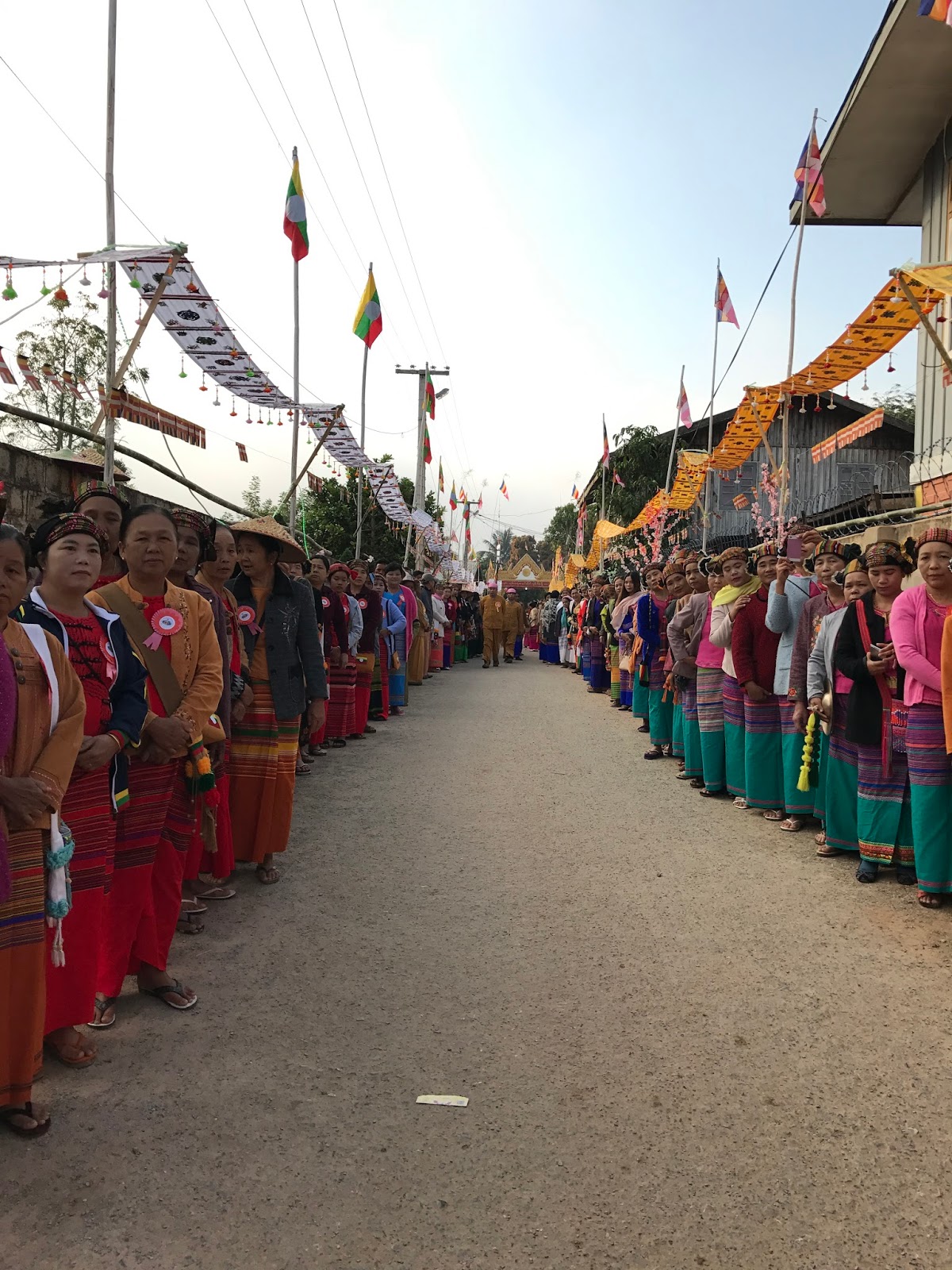
We were reminded that the opening ceremony   would be at 8;00 am . I got there at that time hoping to get into the Dhammaryone which is inside the compound of  Kan Oo monastery, but was amazed to see the short lane to the monastery lined with groups of people, young and old, men and women in their traditional Shan dress. The colour of men’s dresses did not vary much, but each group of women wore  the same colour , and as there were many groups the place looked like a colourful flower garden. The lane was also decorated with flags and  long tungs (  long pieces of cloth with decorated panels  which people offered to get merit ),so that the scenery was so colourful and fascinating that nobody could resist taking photos.There will be the opening of the entrance gate here.
         

  Before  long the cutting of the ceremonial ribbon took place. The cutting was performed by the venerable Sayadaw Aggacina, abbot of Aung Mingalar Monastery and air balloons were released into the air. After that the Sayadaw was escorted into the monastery where the Sukhitaron Dhammaryone  is situated. After some preparations were made the ribbon cutting for the opening of the Dhammaryone  itself  took place.
      

  After the ribbon cuttings were done the people who had lined the lane earlier got into their concerned groups and walked around the Dhammaryone. Sounds of Shan Ouzi and gongs and linguin filled the air and seeing them singing and dancing our hearts were filled with happiness and joy. Women and girls who were not in the dance group carried offertories at chest level and the Padetha pin which Shans called  Toun (tree … tree where offerings are hung )was carried by men and boys. They didn’t carry it quietly , but also played  with it , pulling it to one side and then the other,sometimes nearly crashing into people watching at the side of the passing line of people. I don’t know the meaning of why they do like this but it may be just for fun or to make them forget the tiredness.
       

In this way they circled the prayer Hall 3 times and then went to rest. There was Sar Haw ( recitation of Bhudda’s teaching  and life stories of Buddha ) and people who came to donate money for the Prayer Hall and also for the 3 stories  Hsoon Sar hsaung ( Mess Hall for Sanghas ) that is not fininished yet, listened to that. Everybody who came was offered food the whole day which was donated by some devotees.

To be continued….


Friday, January 27, 2017

N 84  The Tea Ceremony I had participated in

I was not in Japan , but at the Japanese ambassador’s residence. I had never dreamt to be in such a place. But because of a desire and some words I had uttered, that I who shun societies and activities had to be at the said place.

I had only spoken of my desire to plant cherry trees in Taunggyi, not only the native flowers , but also new species too. ( My blog No 7 The Cherry Trees of Taunggyi ) But now due to the efforts of the  people concerned the special Sakuras from Japan had finally reached our Myanmar soil and would  be handed to me as Taunggyi’s representative at this ceremony.


Ma April, the main person to make  this purpose successful made arrangements for me to get there. There were about 15 invited guests  and all  were  people who had helped to get the Sakura plants legally into the country. Also present  were needless to say the Sakura Exchange Association headed  by Mr Yamamoto and some Japanese nationals .

After a speech explaining why this ceremony was held by one Japanese personnel and my thanking speech, I had to walk to the top of the room  and received a model Sakura plant from Mr Yamamoto.

Thus the purpose of the ceremony concluded and some entertainment began. First a Japanese man sang a traditional song accompanied by his musical instrument, the Biwa. After that the tea ceremony began, but as the room is small we had to go in 6 at a time.
The room is fixed with tatami mats and in one corner is an alcove which displayed a hanging scroll. There is an adjoining room from where foods can be brought into this room. At the top the tea master who would be preparing tea sat in a kneeling position. We all sat at the end near the entrance in  kneeling position too . The tea master and all the Japanese ladies who were  helping there all wear kimonos.

At first the ladies brought us a small wooden plate with a lump of mochi ( Japanese rice cake ) and 2 candies, one in the shape of a cherry blossom, because this ceremony was about Sakura, and the other in the shape of waves. Oh… how artful are Japanese. These sweet candies had to be taken first because the tea is a little bitter, one lady explained to us.

When the plates were placed in front of each of us the giver as well as the receiver had  to place the 2 hands on the floor and bow to each other. While some started to eat the cakes the tea master started to prepare  the tea. He put some tea powder ( green colour )in a ceramic bowl and took some hot water from a ceramic jar which was in front of him  using a  a bamboo cup with a long handle and poured it into the ceramic cup and stir it with a tea whisk, so that it turned into a thick mixture .

Then one lady took the tea cup with both hands and placed it in front of the first guest  who was nearest to the tea master. Bows were exchanged once again and then the guest took the bowl with 2 hands and placed it in his left hand . Also to  hold the bowl with  his right hand he had to spread his thumb and pointer apart and placed them around the rim of the  bowl. He turned the bowl clockwise 2 times, as was the custom.  Before taking a few sips the  guest  bowed to the second guest.  After that the guest wiped clean the rim of the bowl and then put it down on the floor.

Tea was made and offered to one at a time. When our  turn came we had to be instructed again and we tried to do our best.

Japanese tea ceremony is meant to demonstrate respect through grace and good etiquette.I as well as many other people have heard of this tea ceremony , but I think only a few lucky people  had   experienced it. Beside receiving special Sakuras for our Taunggyi today I was also lucky enough to have to experience Japanese tea ceremony . So I am thankful  to the Japanese Sakura Association for the special Sakuras, and to  all people who made it possible for the Sakuras to reach our hometown, to HE the Ambassador for not only hosting this ceremony but also let us taste a piece of Japanese culture. As for me it is an experience I am not going to forget.


Saturday, January 14, 2017


Travels in Vietnam
N   83   Hoi An Old Town

When we got up after our first night in Danang we were disappointed. The weather was not sunny and good. It was raining lightly and the sky over the sea was grey and gloomy. Seeing the trees on the roadside swaying I perceived that it  was windy too.

But that was the only day we would be staying in Danang and we had plans to visit Hoi An the old town. So good weather or not we had to go out. Maybe the rain will stop and the weather become clear later I hoped.

The distance from Danang to Hoi An is nearly 30 klms and the same route as the Marble Mountains. So it did not take long to reach Hoi An. The rain had not stopped as we had hoped , but getting somewhat heavier that while somebody was acquiring entrance tickets we busied ourselves buying umbrellas and cheap ponchos.We learned that we will be given a guide to guide us through the town.

So we started walking on the wet pavements of the town. Hoi An though it is a UNESCO World Heritage Site is not an occasionally visited deserted old place, but is a lively inhabited town where people are still living  in well  preserved centuries old houses ,built of brick and wood, their lives evolving around daily activities .It is  a well preserved example of a 15th to 19th century trading post . But as it is a tourist destination now their livelihoods are more or less related to the tourist industry .


The guide ( a woman ) first took us to an old family house. It is Tan Ky house. Taking care to step on the wet small courtyard we entered direct into a living room where we can see an alter dedicated to ancesters . And on the wall are old photos of deceased family members. There a girl who is a descendant of the family explained to us about the crab shell shaped ceiling supported by 3 beams in this room. We also saw a set of antique settees in the room.After that we wandered into the back of the house and saw what should have been sleeping quarters transformed into souvenir shops.

Then she took us to visit a silk weaving house. The steps from silkworm feeding on mulberry leaves until the weaving of silk are displayed here. And they also sell silk fabrics, scarves, clothing etc. The silk scarves some of us bought there for 12$ can be bought at some other shops at half the price.

We walked again leisurely on the streets that had only a few vehicles, peering into shops, when we find things we like to purchase, or just looked with interest. The guide took us to a Chinese meeting hall which is nice to take photos.

The next place we visited was an agar wood sculpture industry house.There are some agar wood sculpture work and incense making downstairs and on the first floor there is a display of Vietnamese paintings.

Then we came to Phung Hung Ancient House. Like in Tan Ky House there is a girl to explain to us about the house. It is one of the most famous architectural buildings in Hoi An, considered to be a cultural heritage of the town. It was built in 1780 and was mainly made of wood with 2 stories. The architecture of Phung Hung is a combination of Vietnamese, Chinese and Japanese styles.It is a wonder that a 200 years old wooden house is still intact and usuable.

There is a set of wooden settees downstairs, which some parts of it are inlaid with mother of pearls. ( Vietnamese are good at that craft )  Ko Aung one member of our group jokingly asked the girl how much is the price of it , and she replied  “ not for sale “. Well …..even if they are for sale they should go to auction houses like Sotheby or Christie I thought.

Lastly she took us to the Japanese bridge which is  one of the tourist attractions and did some explaining to us. It was constructed in the early 1590s by the Japanese community to link them with the Chinese quarters. In those times many Japanese and Chinese came to do merchandising and settled in Hoi An . The entrance to the bridge is guarded by weathered statues; a monkey on one side and a dog on the other.There must be some legends concerning them I thought .


Then the guide told us that was the end of the tour and if we want to explore more we do so freely by ourselves. I asked where the famous lantern making industries are and she just pointed to over the other end of the river. We also hadn’t  seen ceramics industry and would be glad to see one. But because it was wet and time for lunch , everyone didn’t have the heart to walk more. So we just turned  back to the way we had come towards where our car was waiting for us. 

Thursday, January 5, 2017


Travels in Vietnam
N  82  Danang Part 2

After all of us had come back we drove to the city along the beach road to check into our hotel.

After dinner that night we went to visit the famous Dragon Bridge . With colours changing every few minutes it is really pretty and impressive. Lighted boats were also ferrying in the Han River below it.We could also see a ferris wheel and  the Han River Bridge which is a swing bridge that  swings open in the daytime and swings shut at night to allow shipping traffic to pass along the river.   Our driver told us there are 8 bridges in Danang. So I would like to call Danang a city of bridges and oh… also a city of lights because we saw lights everywhere . It is very well lighted. I felt thankful that we had chosen to visit the bridge at night time.

Because Danang is on the coast and we had booked a hotel on the beach we had imagined that we would have some activities on the beach , but because of the weather this was not to be. From the next day it was raining that we can’t even go to the seaside. We had chosen the wrong time to come to this part. (we heard from June to September is OK )So we had to be contented by just looking at the windy and gloomy sea.

After we came back from Hoi An , lastly we visited the statue of the Goddess of Mercy. It is on a hill not far from the city. The rain had not stopped but even became heavier, so that  we had to get down in the downpour with umbrellas and ponchos. We had to cross a wide courtyard to where the statue stand, and because rainwater was flowing over the tiles even our walking shoes  got soaked . So after paying homage to the Goddess (ours or not ) we did not spend much time there and got back into our car to come back to the hotel.

Danang had been in my memory since long ago. Maybe from the time of US- Vietnam war. It had been home to a major air base used by both the South Vietnamese and US Air Force then. I had not dreamt of visiting it . Some people also say that there are not much to see in Danang. That is not true. In my opinion every place  we haven’t been to is worth a visit. Whether it be in our own country or abroad. Danang is a place new to me and I am contented to visit it and I also thank my fate that had enabled me to do so .

( a large part of my thanks goes to my husband USTM who takes care of all the expenses )

Wednesday, January 4, 2017

Travels in Vietnam
N 81    Danang   (   Part  1 )

 The distance from Hue to Danang is about 100 klms. So we decided to travel there in a hired van , a 10 seater like we always used the previous days.

We visited the Thien Mu pagoda which is just outside the city of Hue, on the bank of the Perfume river . It has 7 stories, and is the tallest  religious building in Vietnam. The  construction of this pagoda is said to begin in 1601 followed by renovations during the course of time.

After driving sometime we reached Minh Mang’s (reigned 1820 -1841 ) tomb. Upon entering the precincts we saw the usual figures of elephant, horses, and court officials first. Then the stele house, salutation court, temples, pavilions, and oh… I nearly forgot , the lakes.So comments were given that these were  things tombs of emperors cannot do without. Quite different from tombs of Burmese kings which were so simple and without lavishness.

When we were nearing Danang city we started to see wide expanse of  water which the driver told us is a bay. Before we reached the city we  had lunch of seafood at an open restaurant,  which had to be crossed by a long bridge . It took some more driving along the beach to get into the city. It may be about 3:00 pm when we finally reach Danang.

Because there was still time I told the driver to take us to Marble Mountain. On the way there he took us to a marble statue selling mall for a rest. The marble figures big and small on display there are amazing.  They are of different sizes and colours, of religious figures, of animals and also modern sculpture.The Vietnam handicraft of marble sculpture is amazing and impressing that I even have a desire to take one Buddha statue home. And about marble lots of marble are produced around here that the marble mountain we were going to visit got its name from it I thought.

And so we arrived at Marble Mountain. I heard that there are 5 marble mountains , but we were able to visit this  main one only. As there is an elevator  we use it to climb to the top.Coming out of the evevator we reached a landing with railings where we can take photos and watch the panoramic view which is amazing.We could see the city at the low level and also the expanse of water far away.

 After that  we set out to explore around. Most places are places of worship, of Buddhism, and Confusionism, and there also are caves, tunnels, grottoes filled with these religious figures. In some places there are depictions of Buddhist religion scene such as the scene of Buddha’s birth, and Bhuddha giving sermon at Sarnath carved in white marble. And to my surprise , in a nitche of a mountain surface I saw a big sitting Buddha stature which I had never seen before. Some of us went farther to look around but as the path goes to higher ground that I and my companion did not follow, but chose to go down the steps  we 


saw there. I made a mistake because the steps are steep and each step is high too. I dared not look down but with his assistance climbed down step by step .But my knees got pained until I changed the leg that step down first. I felt so much relieved when I reached the foot.


Friday, December 30, 2016


Travels in Vietnam
N   80  Hue City

Hue(pronounced Hway ) is a city in Central Vietnam, that was the seat of Nguyen dynasty emperors and the national capital from 1802 to 1945. As it is an old city it has many structures of historical importance, such as the 19th century citadel surrounded by a moat and thick stone walls. Other remarkable places are the tomb of emperors such as Tu Duc, Khai Din, Min Mang and also famous pagodas.

After we checked into our hotel and were ready to go out it was nearly noon. We asked our driver to take us to Emperor Tu Duc’s tomb first. It was not very far from the city and before long we reached there.

It had been raining since we arrived in Hue. But not so heavy. Just a light one. We walked  into the compound which is 12 hectares wide and surrounded by thick walls. What we first saw was a lake with low water level and the water in it looks stagnant.But with the old pavilion in the background and trees (many magnolias ) the scenery was magnificent. After that  we walked onto higher level.

I had already learned that there are nearly 50 constructions of palaces, pavilions, theatres, courtyards, royal gardens, lakes and such as  should fit an emperor.They took 3 years to build (1864- 67)  And now I was seeing  them with my eyes . The stone stele in the stele pavilion is the biggest in Vietnam. The narrative inscribed on it was composed by the Emperor (reign 1848-1883 ) himself.

Tu Duc’s tomb is not only one of the beautiful works of Nguyen Dynasty but it is also a romantic scenery of mounts and lakes.

Then we were taken to visit Emperor Khai Din’s tomb. The car stopped directly in front of the steps leading to the tomb complex. The archway at the top of the staircase had captivated me that I had a wish to take a group photo on the stairs. But this did not become real because someone was not interested and didn’t even come up with us.

I tried to climb up the stairs resting 2 times and finally got to the top. And it was well worth to have done so because I could see a lovely viewpoint over the mountain from the top.

There is a vast courtyard in front of the stele pavilion and in the courtyard are figures of elephant, horses, and court officials which emperors could not dispense with. There are these in every tombs.

Climbing another set of stairs we reached the Khai Thanh palace with intricately carved decorations on the external walls. There are 3 separate halls, the palace, the Royal Crypt and the Altar Hall.The walls are decorated with inlaid colorful glass and porcelain pieces. There is the decorated sarcophagus, built in the form of a throne with the figure of the  seated emperor over it as well as items retained from his reign.

Emperor Khai Din was the 12th and the last emperor of Nguyen dynasty who reigned from 1916 to 1925. His tomb is a blend of western and eastern architecture built from 1920 to 1931.

After having a late lunch at a Vietnamese restaurant we went to visit the complex of Hue monuments. (UNESCO World Heritage site ) 

The first structure we saw was the Hue Citadel. It is not old as Hanoi Citadel because it was built only in 1804 by Emperor Gia Long.

Our car drove past the citadel and into the car park. We had to leave our car here, and hire an electric car to get into the complex. It did not take us to see the Citadel but took us direct into the palace complex. The complex is huge. I learned that it is 2 klms by 2klms. So to explore it on foot is impossible, unless one takes 2 or 3 days. And there are many places to visit. Gates, courtyards, lakes, palaces, pavilions,  and such pertaining to Emperors. Unfortunately we didn’t have a guide to explain to us.We understood what one building is only from what our driver told us.
By the time the last emperor stepped down in mid 20th century this  Purple Forbidden City had acquired many dozens of pavilions and hundreds of buildings. But the US –Vietnam war and other natural disasters had caused substantial damages to the buildings. And so many of what we were seeing were reproductions of them. But they look authentic and really impressive especially the Emperor’s mother’s palace , the museum and the royal theatre.  They are well worth the price of the pricey tickets that we had to acquire to go in .
(Some facts and photos from the internet )